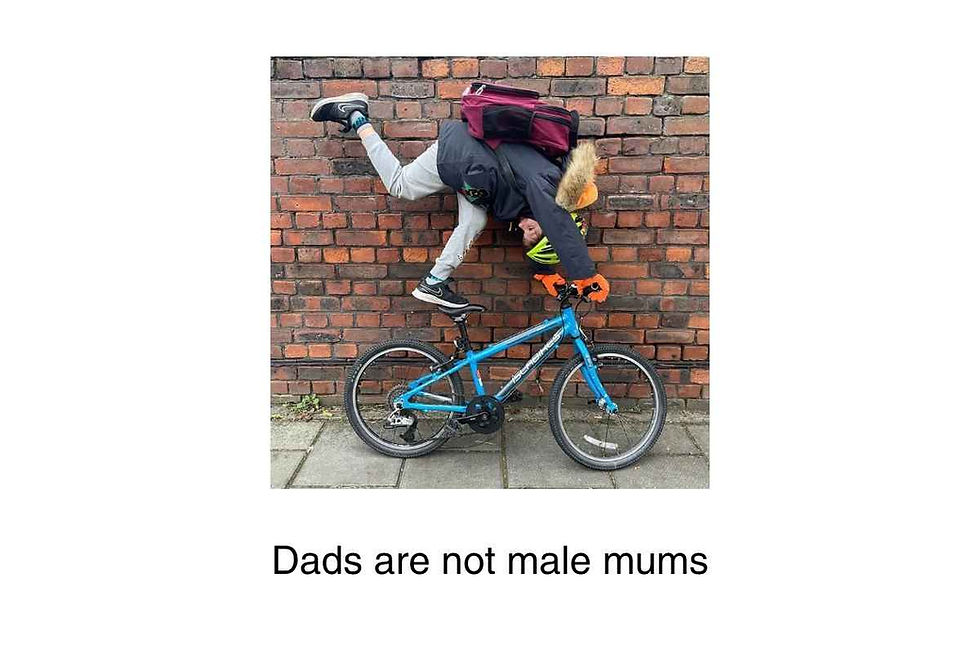
Dads are not male mums
Updated: Oct 5
Before reading further, a little context. This post borrows from the work of Dr Anna Machin, including the title. Anna researches human relationships, love and fatherhood and has spent years looking at the role dads can play in children's development. Her work is brilliant, accessible and well worth checking out at Anna Machin (@dr_amachin).
So, last week was back to school.
I did the first week of the school cycle with my child, who's just started Year 4 and turned nine. We'd cycled together over the summer, they'd passed Bikeability last term and I'd encouraged them to cycle on the road all the way to school.
I ride behind them, keeping them in full view and positioning myself on their outside so I'm between them and passing traffic. One of the roads is very quiet. The other is busier, but has a 20mph limit and plenty of measures designed to slow cars down. I also wear a fluorescent pink gilet, partly for visibility and partly because apparently that's who I am now.
Then one morning my wife came too.
On the first, quiet road, the three of us cycled and chatted together. When we reached the busier road, our child hopped confidently onto it, just as we'd done all week.
Mum said to stay on the pavement because the road was busy.
Our child proudly replied that they ride on the road now.
Cue one of those slightly awkward parenting moments where mum and dad realise, in real time, that they have completely different ideas about what should happen next.
We all made it safely to school on the road, but it sparked an interesting question...
When two parents approach something differently, whose way do we follow?
Different doesn't automatically mean wrong.
This is where Anna Machin's work gets interesting.
Her research explores some of the ways fathers can interact differently with their children, particularly through play, challenge, exploration and encouraging children to test themselves.
There's some fascinating biology behind this too.
Oxytocin - one of the hormones involved in bonding - rises in both mums and dads as they interact with their children, but research has found different patterns in the kinds of interactions associated with those rises.
In mothers, it has been linked particularly with affectionate, nurturing contact. In fathers, it has been linked more strongly with stimulating, playful interaction.
That doesn't mean mums don't play or dads don't cuddle. Obviously they do.
But it does suggest there can be different pathways into bonding and connection, and that play can be a particularly powerful one for dads.
And that's the bit I find really interesting.
Dads don't need to become male versions of mums in order to build brilliant relationships with their kids.
There can be value in approaching the same child differently.
One parent might instinctively protect a little more. Another might encourage the child to try something slightly harder. One might comfort first. Another might say, "Give it another go."
Neither approach has to be better.
Of course there are boundaries. Safety matters. Children are different. Context matters.
And "doing it differently" isn't an excuse for doing something reckless.
But there can be more than one good way of getting to the same place.
Dads need confidence to find their own way
I think this matters because dads can sometimes lack confidence in their parenting role.
That's my observation rather than something I'm attributing to Anna's research, but I've seen plenty of dads look to mum as the default expert on the child and then follow her lead.
Sometimes that's completely sensible.
But sometimes dad needs the confidence to work out his own relationship, routines, games, conversations and ways of learning with his child.
Not because mum is doing anything wrong.
Because children can benefit from having different relationships with the different adults who love and care for them.
And when dad does something differently to mum, it doesn't instantly make it wrong.
It might just be another route to the same destination.
Back to the bike
It's probably worth adding that I've cycled long distances on my own since I was 13 and have raced bikes across the UK and Europe.
So my level of confidence putting a nine-year-old onto a London road is, unsurprisingly, not necessarily the same as my wife's.
She wasn't being overprotective.
I wasn't trying to be reckless.
We were looking at exactly the same child, on exactly the same road, through two different sets of experiences.
And perhaps that's the interesting bit.
Our child gets both.
The confidence to have a go, and someone making sure the risks have actually been thought about.
This isn't mums v dads
None of this is a parenting competition. And none of that means there’s one ‘right’ family set-up. Children can thrive with same-sex parents, single parents, blended families, kinship carers and many others - the point is that every parent or carer should feel able to step forward, build their own relationship with the child and find the role that works for them.
At Dads Kids Club, we're focused on getting more dads and male carers involved in their kids' learning and ultimately their lives.
That's not because mums need to step back.
It's because dads need to step forward.
We believe both can play important roles in children's lives and that giving fathers confidence to develop their own relationship with their children can be a really positive thing.
Dads don't need to be male mums.
They need to be engaged, loving, interested, present dads - and work out what that looks like for themselves and their kids.
So I'm interested..
How do you and your co-parent navigate doing things differently while still ending up in the same place for your kids?
Scott
I'm Scott Leonard. Founder of Dads Kids Club. We're a dad-led Community Interest Company that invites men to get more involved in their kids' education - improving children's educational engagement, men's mental health and life opportunities for both.
We invite, train and mobilise dads, step-dads, grandads, uncles and male carers to co-run screen-free, hands-on sessions at their children's primary schools and community spaces. Men share skills, connect and bond. Children enjoy beyond-the-curriculum activities - building confidence, new skills and memories that last. We celebrate all masculinities, backgrounds, identities and beliefs.
If you work in education, family services, philanthropy or simply believe in what happens when dads show up - I'd love to connect.
📧 info@dadskids.club 🌐@DadsKidsClub (on Instagram)


Comments